
Having an
AdBlue or
SCR Problem?
AdBlue and SCR faults can affect cars, vans and trucks, causing unplanned downtime across every vehicle type. We use dealer-level diagnostic systems to identify the exact failure — not guess, replace parts without evidence, then clear and hope.
Left unresolved, faults progress from a warning light through engine derate and reduced power to a restart countdown — and eventually a non-start situation that stops your vehicle entirely.
What an AdBlue warning light means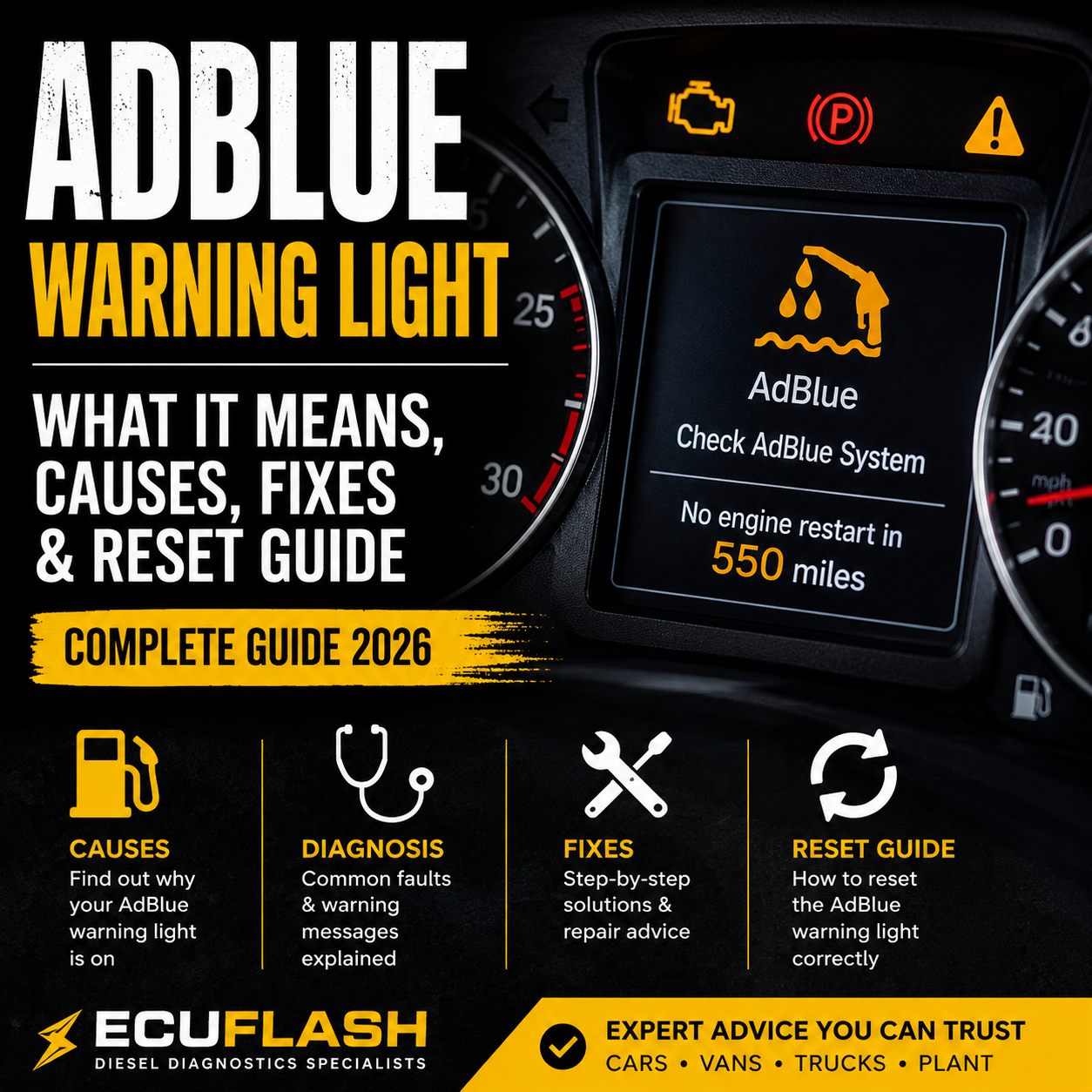
Common Fault Types
What Are You Experiencing?
SCR faults present in many different ways. Identifying the correct root cause — rather than treating the symptom — is what prevents repeat failures and unnecessary part costs.
AdBlue Warning Light
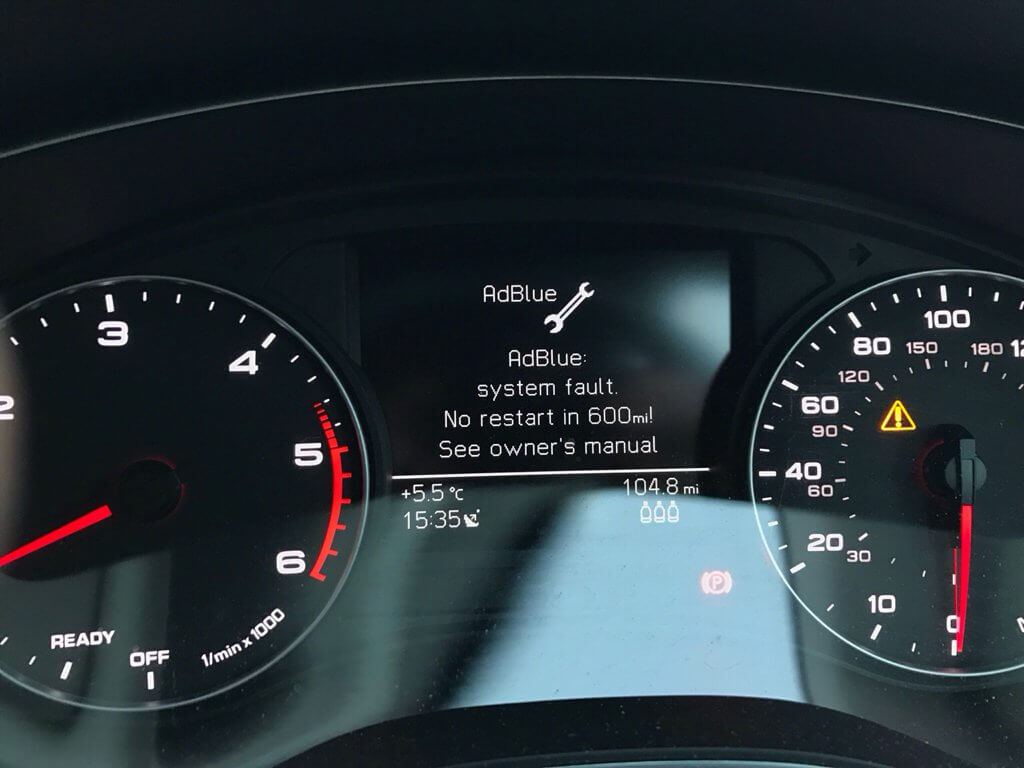
The first sign of a problem. An amber warning appears when fluid is low or the SCR system detects an anomaly. Ignoring it leads to progressive derates — the warning escalates through multiple stages before the engine is restricted.
NOx Sensor Faults
The single most common SCR failure. Pre- and post-catalyst NOx sensors monitor exhaust reduction efficiency. They fail due to soot contamination, thermal stress, and connector corrosion. Fault codes: high NOx output, sensor signal out of range, comparison faults between upstream and downstream sensors.
SCR Catalyst Faults
The catalyst converts NOx using the AdBlue urea. It can fail from contamination with wrong fluid, thermal damage, or simply age. ECU monitors conversion efficiency — if the ratio falls below threshold, it flags catalyst deterioration codes.
Pressure Faults
The dosing pump must maintain precise pressure — typically 5–9 bar depending on system. Low pressure indicates a failing pump, air in the lines, or a blocked filter. High pressure suggests a blocked injector or return restriction. Both trigger dosing system faults.
Dosing / Injector Faults
The dosing injector atomises AdBlue into the exhaust stream. It operates in a harsh heat environment and is highly susceptible to crystallisation blockage. A blocked injector reads as low flow / no flow, and a failed injector heater circuit is also common on cold starts.
Crystallisation
When AdBlue evaporates on the injector tip, nozzle, or in the lines, solid urea crystals form and restrict flow. Visible as white powder deposits around the injector area. Crystallisation is often caused by injector tip retraction failure or system purge not completing.
Wiring & Connector Faults
Frequently misdiagnosed as component failure. The AdBlue system wiring — NOx sensors, pump, tank heater, injector — runs through harsh environments. Corrosion, chafing, and connector failure cause intermittent or permanent faults. We always inspect wiring before recommending part replacement.
Engine Derate
Once an SCR fault reaches a critical threshold, the ECU enforces power restriction. On most platforms this is progressive: initial derate to ~75% power, then further stages to 50% or lower. The vehicle remains mobile but is unusable for haulage or field work.
Reduced Power Mode
A sustained or worsening derate where the engine operates well below its rated output. Fuel consumption increases, the vehicle cannot maintain speed or carry load. Operating in this state for extended periods causes additional drivetrain stress.
Restart Countdown
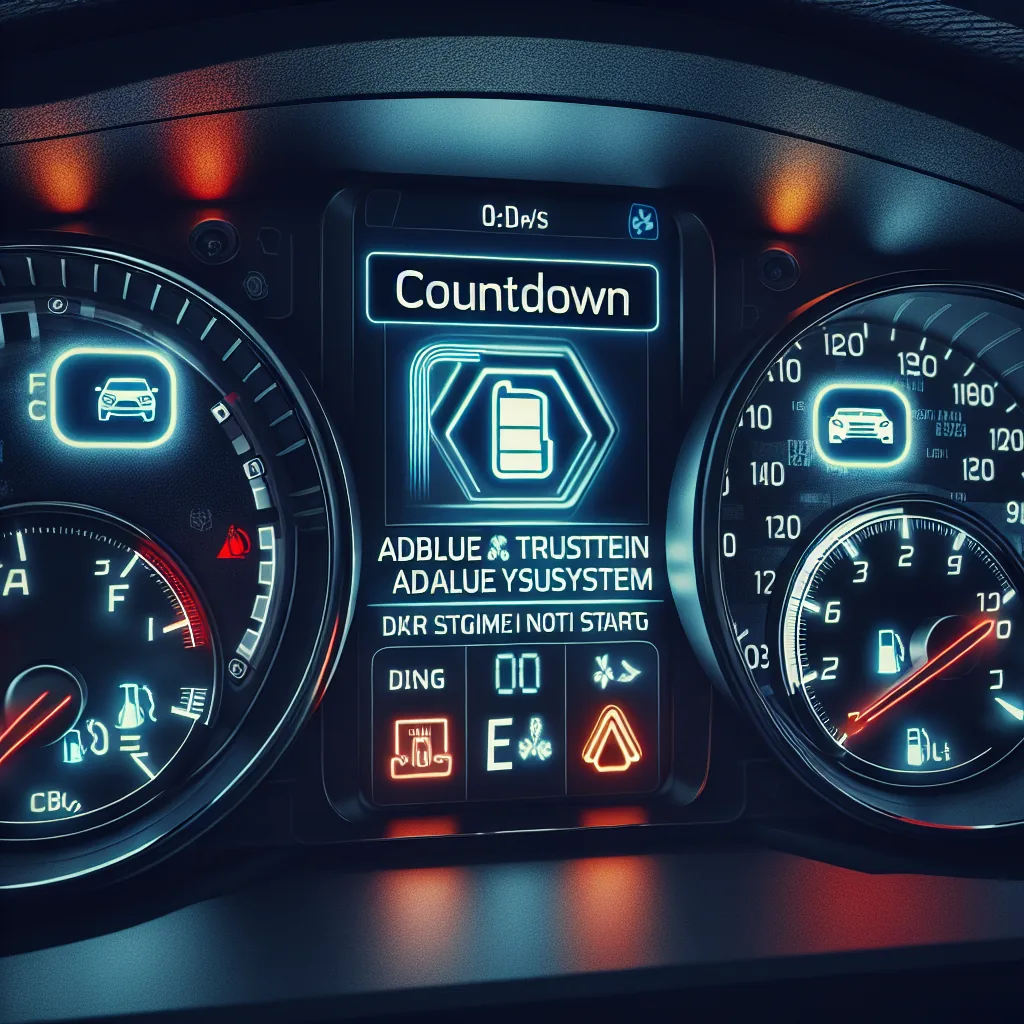
Manufacturers including DAF, Scania, Volvo, and Mercedes implement a visible countdown timer on the instrument cluster. Once triggered by a serious SCR fault, the counter decrements every time the engine is stopped. When it reaches zero, the engine will not restart without diagnostic intervention.
Non-Start Situation
The most severe outcome and fully preventable with early action. The countdown reaches zero and the engine refuses to start. Recovering from a non-start requires dealer-level diagnostic access to read and clear the fault, reset the countdown flag in the ECU, and verify the root cause has been resolved.
Our Diagnostic Approach
We Find the Fault —
Not Just the Code
Many workshops read the fault code, replace the most obvious component, and clear the light. This is expensive and rarely permanent. The root cause — a failing wiring loom, a partially blocked injector, a pump operating at the edge of its pressure range — goes undetected.
We use DAF DAVIE, Scania SDP3, Volvo PTT, and Jaltest to access live SCR data: pump pressure, dosing quantity, NOx conversion efficiency, upstream vs downstream sensor comparison, and full actuator test sequences. This gives us a complete picture of the system before any parts are ordered.
- —Live NOx pre- and post-catalyst monitoring
- —Dosing pump pressure and flow rate logging
- —Injector actuator testing with flow verification
- —Wiring continuity and resistance checks
- —ECU freeze frame and historical fault review
By Manufacturer
Commercial Truck Manufacturer Guides
These manufacturer guides focus on truck and HGV SCR systems. Diesel cars and vans with AdBlue are supported where their SCR system and ECU can be confirmed — use the registration check so we can identify the appropriate diagnostic route.
DAF
NOx sensor and SCR pressure faults are the most frequent on Euro 6 DAF trucks. The 2017+ platform introduced new SCR configurations that are particularly sensitive to fluid quality and injector condition.
DAF AdBlue GuideScania
Scania SCR systems on DC13 and DC09 engines commonly develop NOx sensor faults and dosing unit failures. The SDP3 diagnostic platform gives deep access to live SCR data including pump pressures and dosing quantities.
Scania AdBlue GuideVolvo
Volvo FH and FM trucks regularly suffer NOx sensor issues and SCR catalyst efficiency faults. The Volvo PTT system provides full actuator testing capability to isolate faults without unnecessary part replacement.
Volvo AdBlue GuideRenault Trucks
Renault Trucks (sharing architecture with Volvo) experience similar SCR issues. The T and C-series are prone to dosing injector crystallisation and wiring faults on the NOx sensor circuit.
Renault Trucks AdBlue GuideMercedes-Benz Trucks
Mercedes Actros and Arocs develop AdBlue pump failures and NOx sensor faults with high frequency. The BlueTec system on OM471/OM473 engines has known sensitivity to fluid contamination.
Mercedes-Benz Trucks AdBlue GuideMAN
MAN TGX and TGS trucks with D26 and D38 engines commonly suffer SCR catalyst efficiency faults and upstream NOx sensor failures. Wiring harness issues in the SCR sensor circuit are also well documented.
MAN AdBlue GuideIveco
Iveco Stralis and S-Way AdBlue systems develop injector faults and crystallisation problems, particularly on vehicles operating in stop-start urban cycles where the purge cycle does not complete.
Iveco AdBlue Guide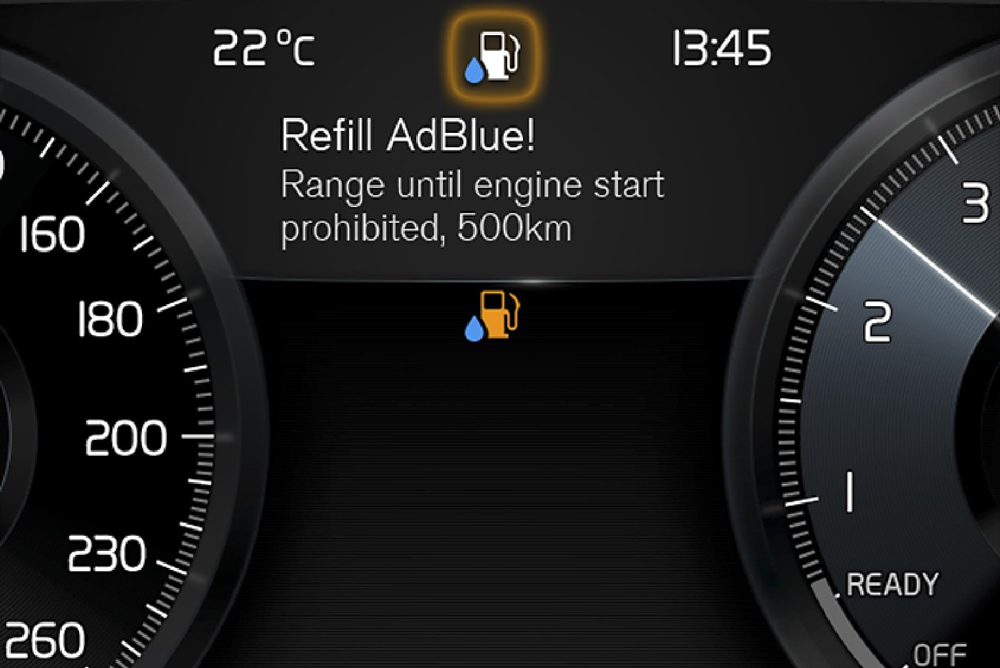
Don't Wait
Act Before the
Countdown Starts
The moment an AdBlue warning light appears, the fault clock starts. Most manufacturers give you a window — sometimes as few as a handful of engine stops — before the restart countdown locks the vehicle.
Calling us at the warning-light stage costs far less in diagnostic time than recovering from a non-start. We can often diagnose remotely and have you back on the road without your vehicle needing to travel to us.
Critical reminder
Clearing fault codes without resolving the root cause does not reset the countdown counter on most platforms. The vehicle will reach zero faster next time.
Agricultural
Tractor & Plant Machinery SCR Faults
John Deere, Case IH, New Holland, Fendt, Claas, and Massey Ferguson all use SCR systems on Stage V machinery. An engine derate in the middle of harvest or planting carries its own cost. We provide priority diagnostics for agricultural vehicles — contact us for availability.
Need AdBlue or SCR Help Now?
Call us direct or submit your details and we'll come back to you within the hour during business hours.