
DAF
AdBlue
Problems
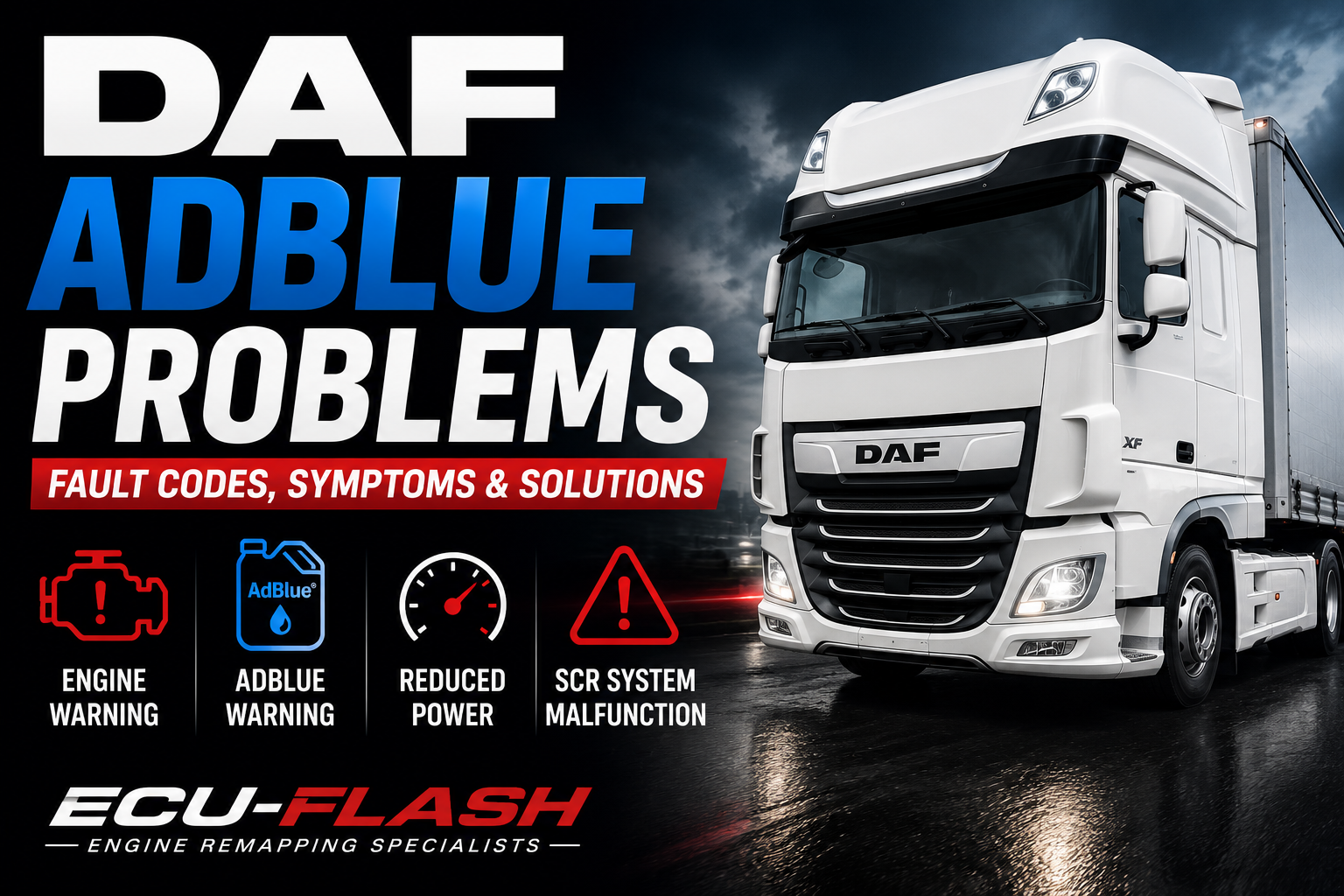
Modern Euro 6 DAF trucks — XF, XG, XG+, CF, and LF — rely on a sophisticated SCR (Selective Catalytic Reduction) system to meet emissions legislation. While these systems are effective, they have become one of the leading causes of commercial vehicle breakdowns. The ACM (Aftertreatment Control Module), pump module, NOx sensors, and dosing injector each represent a potential failure point, and a fault in any one can quickly escalate to engine derate and, if left unresolved, a non-start situation.
Vehicles Covered
Engines
Common Symptoms
Fault Codes — DAF DAVIE / EAS / SAE P-code
Common DAF AdBlue & SCR Fault Codes
A DAF code identifies the system area needing diagnosis; it does not automatically prove that a sensor, pump or catalyst has failed.
DAF DAVIE may show EAS and aftertreatment information alongside SAE P-codes. Exact wording and applicability vary by MX/PX engine, ACM software and Euro generation.
| Fault code | System | Common description | Possible causes |
|---|---|---|---|
| P20EE | SCR efficiency | SCR NOx catalyst efficiency below threshold | NOx signal quality, dosing quantity, AdBlue quality, exhaust temperature or catalyst performance |
| P204F | Reductant system | Reductant system performance | Pressure, fluid-quality, dosing, line restriction or sensor data fault |
| P20E8 | AdBlue pressure | Reductant pressure too low | Pump output, leak, blocked line, crystallisation or pressure-sensor data |
| P2200 | NOx sensor | NOx sensor circuit fault | Sensor circuit, connector condition, wiring or sensor performance |
P20EE
DAF P20EE — SCR efficiency below threshold
What it means
The aftertreatment system has calculated that the expected NOx conversion is not being achieved. It is a diagnosis starting point, not a catalyst replacement instruction.
Common causes
- •Biased upstream or downstream NOx data
- •Incorrect dosing or low reductant pressure
- •AdBlue quality or contamination issue
- •Exhaust-temperature or exhaust-leak influence
- •SCR catalyst performance
Symptoms
AdBlue or SCR warning · Reduced power or derate · Emissions warning · Restart counter on affected systems
What ECUFLASH checks
ECUFLASH compares live NOx, temperature, pressure and dosing data in DAVIE, then checks the relevant wiring and physical system before recommending a repair.
Source basis: DAF Emission Aftertreatment System technical information · Existing ECUFLASH DAF AdBlue technical material · SAE/ISO OBD generic-code terminology, used only where the vehicle presents SAE P-codes.
NOx Sensor Faults on DAF Euro 6
The upstream and downstream NOx sensors are the most common failure point on DAF Euro 6 trucks. The upstream sensor monitors exhaust gases entering the SCR catalyst; the downstream sensor verifies the catalyst is achieving the required NOx conversion efficiency. When either falls outside its expected signal range, the ACM logs P2200 or P2201 (sensor circuit) or P20EE (catalyst efficiency below threshold). DAF NOx sensors are particularly susceptible to soot contamination, water ingress at the connector, and thermal cycling damage from the extreme temperature range they operate in.
Importantly, a poor NOx reading does not always mean the sensor has failed. An underdosing injector or a deteriorating catalyst will cause the downstream sensor to report incorrect values. Replacing a sensor without diagnosing the root cause frequently results in the same fault code returning.
AdBlue Pump & Pressure Faults
The AdBlue pump on DAF Euro 6 trucks maintains system pressure in the range required for accurate dosing — a loss of pressure below the ACM's threshold generates P208E (Reductant Pressure Too Low) or P204F (Reductant System Performance). Causes include pump wear, internal seal failure, air ingestion from a damaged supply line, a blocked filter in the tank module, or frozen/crystallised AdBlue at the pump inlet in cold conditions.
Using DAF DAVIE we can run the pump in actuator test mode, logging real-time pressure data. This distinguishes between a failing pump, a downstream restriction, and a pressure sensor fault — all of which produce similar fault codes but require completely different repairs.
Dosing Injector Faults
The dosing injector atomises AdBlue into the exhaust stream ahead of the SCR catalyst. On DAF trucks it operates in a thermally demanding environment — close to the exhaust system — and is susceptible to heat damage and injector tip failure. When the tip does not fully retract at engine shutdown, the purge cycle cannot properly flush the supply lines, leaving AdBlue to dry on the nozzle and crystallise.
A blocked injector presents as P204F or P20EE as the ACM detects insufficient NOx conversion. DAF DAVIE actuator tests allow us to command a specific dosing quantity and verify actual flow against expected values — confirming whether the injector, the pump, or the line is the restriction.
Crystallisation
AdBlue is a 32.5% urea solution. When it evaporates — from the injector tip, line connections, or around the pump module — it leaves solid white urea crystals that block passageways and restrict flow. Crystallisation is most common on vehicles operating in urban stop-start duty cycles where exhaust temperatures remain low and the automatic purge cycle at shutdown does not complete fully.
On DAF trucks, crystallisation typically occurs at the injector tip and in the return line connections near the pump module. The white powder residue can progressively block the injector nozzle or restrict the return line — both cause pressure faults (P208E) even when the pump itself is functioning correctly. Detection requires physical inspection of the injector and line connections, not just code reading.
Wiring & Connector Faults
The wiring harness serving the DAF AdBlue system routes through the chassis frame — an environment of road vibration, heat cycles, moisture, and mechanical stress. The NOx sensor connectors (both upstream and downstream), ACM wiring, dosing injector connector, and tank heater circuit are all susceptible to corrosion and chafing.
P2200/P2201 (NOx sensor circuit) faults are regularly caused by wiring issues rather than sensor failure. Before any component is replaced, we test continuity and resistance through the full circuit with DAF DAVIE and physical inspection. Many vehicles arrive with recently replaced NOx sensors that have not resolved the fault — because the underlying wiring issue was never identified.
SCR Catalyst Efficiency (P20EE)
P20EE — SCR NOx Catalyst Efficiency Below Threshold — is generated when the ratio between upstream and downstream NOx readings falls outside the ACM's acceptable range, indicating the catalyst is not converting sufficient NOx. This code can result from: incorrect or contaminated AdBlue fluid (the fluid must be ISO 22241 compliant), insufficient dosing caused by an injector or pump fault, low exhaust temperature preventing the catalyst from reaching its operating window, or genuine catalyst substrate deterioration.
DAF DAVIE provides live NOx conversion efficiency data alongside upstream and downstream sensor readings. This allows us to confirm whether the catalyst is the actual failure or whether it is being incorrectly blamed for a dosing system fault. Replacing a catalyst when the root cause is an underdosing injector is an expensive mistake.
Engine Derate on DAF Trucks
When the ACM determines that an SCR fault has crossed a defined severity threshold, it commands the engine ECU to restrict torque output. The initial derate is typically a moderate reduction — enough to keep the vehicle mobile but far below working capacity. As the fault accumulates or the "Starts Remaining" counter decrements, further stages of derate progressively reduce power.
The derate is proportional to the ACM's assessment of the fault severity and how long it has been active. A vehicle that had fault codes cleared without resolving the underlying fault will have a reduced restart allowance and may enter a deeper derate state more rapidly than a vehicle presenting the fault for the first time.
"Starts Remaining" — Restart Countdown
The "Starts Remaining" counter is a deliberate enforcement mechanism within the DAF ACM and engine ECU, not a recoverable software state. Once activated by a qualifying SCR fault, each engine start decrements the counter. When it reaches zero, the engine will not restart.
Recovery from a non-start DAF requires: genuine DAF DAVIE access to read the current fault state and countdown value, resolution or proper handling of the active SCR fault, and in many cases a formal ACM reset procedure that only DAVIE can execute. Clearing codes with an aftermarket generic scanner will not reset the countdown timer. If your DAF has reached zero restarts — or is close — call us before attempting workarounds that may complicate the recovery process.
Preventing DAF AdBlue Failures
- Use only ISO 22241 approved AdBlue — quality directly affects dosing efficiency
- Investigate the first AdBlue warning immediately rather than waiting for derate
- Repair exhaust leaks promptly — they affect temperature sensor and NOx sensor readings
- Keep the AdBlue tank clean and avoid using contaminated fluid
- Ensure the AdBlue system purge cycle completes at each shutdown — do not cut power immediately after stopping
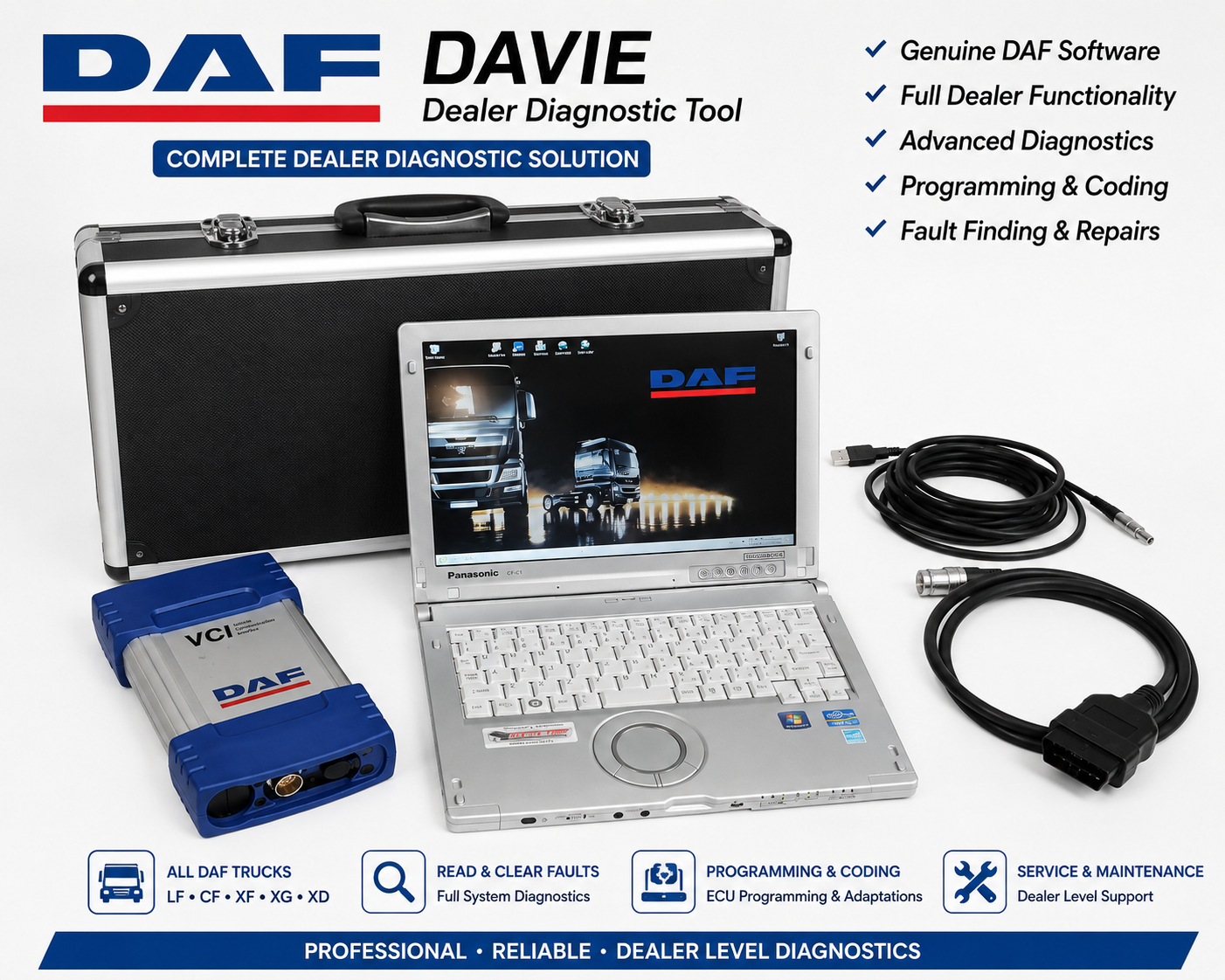
DAF DAVIE
Dealer-level diagnostic system
Our Diagnostic Process
- 1.Full system scan with DAF DAVIE to read all active and stored fault codes
- 2.Live NOx data: upstream vs downstream sensor comparison
- 3.AdBlue pump actuator test — pressure logging under load
- 4.Dosing injector actuator test — commanded dosing quantity vs actual
- 5.Exhaust temperature sensor verification across the aftertreatment system
- 6.Wiring continuity and resistance checks on NOx sensor and ACM circuits
- 7.AdBlue quality sensor reading
- 8.ACM software version verification
- 9.Freeze frame and fault history review to identify intermittent faults
ECUFLASH Experience
We regularly diagnose and repair AdBlue and SCR faults on:
- DAF XF
- DAF XG
- DAF XG+
- DAF CF
- DAF LF
Using DAF DAVIE and over 20 years of commercial vehicle ECU experience.
Vehicle Immobilised?
If your DAF has reached zero restarts or has entered a no-start condition, call us directly — time matters.
01302 20274607929 765432Need DAF AdBlue Help?
Call us or submit your details and we will come back to you quickly. We work with DAF trucks daily using DAF DAVIE.